
What SEND Reform Means for Sensory Environments in Schools
By Beth Smithson, 17/09/26
I’ve spent a lot of time over the last few days preparing my talk for our free Sensory Inclusion Summit, “Inclusive by Design: What SEND Reform Means for Sensory Environments in Schools.”
It has been really useful to properly sit with the different documents rather than just read the headlines, particularly the Schools White Paper, the SEND reform consultation, the Inclusion Bases guidance, the Experts at Hand guidance, the Inclusive Education Estates guidance and the recent House of Commons Library briefing on the reforms.
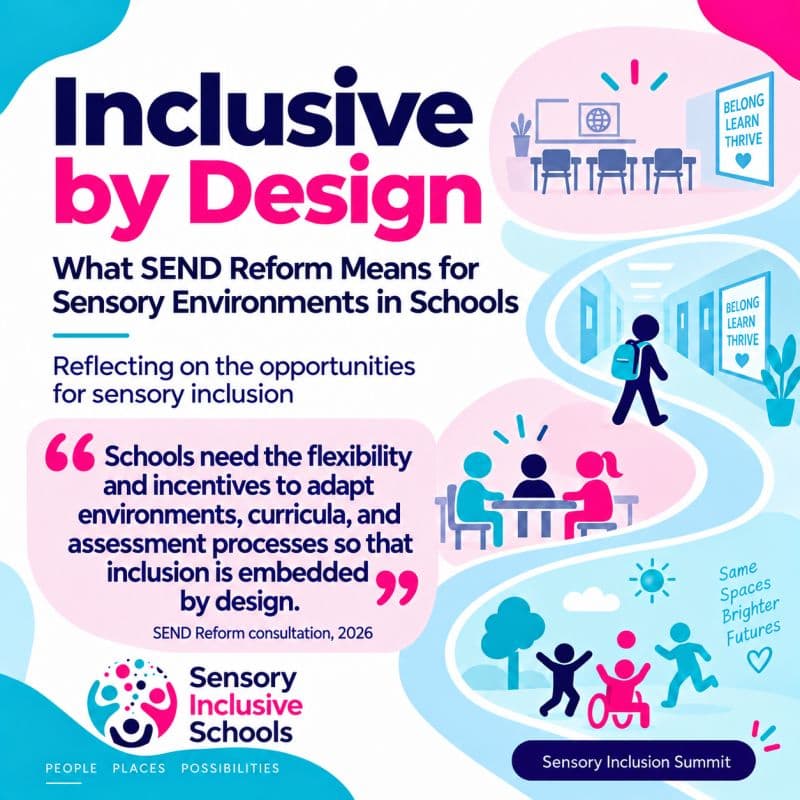
I didn’t want this session to become a talk about whether I agree or disagree with the reforms, because there is still a lot to be worked through and debated. What I wanted to do was look across the documents and think about what opportunities they might create for sensory inclusion.
The more I have read, the more I think there are some important openings here. There is a clear emphasis on earlier support, stronger Universal provision, removing barriers, making mainstream environments more inclusive, investing in workforce training, involving students and families more meaningfully, bringing specialist expertise closer to schools and developing Inclusion Bases.
For me, one of the biggest opportunities is to move sensory thinking earlier. Instead of waiting until a student is already struggling and then asking, “What sensory strategy does this student need?”, perhaps we can ask much earlier, “What is this student trying to participate in, what is getting in the way, and what can we change?”
That takes us well beyond sensory rooms and equipment. It means thinking about the classroom, corridors, dining hall, toilets, changing rooms, playground and transitions across the whole school day. It means considering movement, predictability, choice, physiological needs, sensory joy and how much capacity a student is having to use simply to get through their day. It also means listening properly to students about what those environments are actually like for them and involving them in shaping the changes we make.
The more I have worked through these documents, the more I think there is a real opportunity to make sensory accessibility part of everyday inclusive practice, rather than something we only think about once things have already become difficult.
I’m really looking forward to sharing some of these reflections at the Summit, and I look forward to seeing your comments and questions. You can book your free ticket below.
%20Interoception%20and%20Developmental%20Trauma%20-%2024%20Sept%202026.png)