Reflections from SIS | When a New Sensory Behaviour Appears
By Beth Smithson, 26/05/2026
This week in our Sensory Inclusive Schools drop-in session, we spoke about what the appearance of a new sensory behaviour may mean.
If a student suddenly starts chewing, mouthing objects, covering their ears, seeking more movement, avoiding touch, hiding away, becoming more unsettled, or showing a sensory behaviour we have not seen before, we need to be curious.
It can be tempting to move straight to stopping the behaviour (and we do if there are safety concerns), but a new sensory behaviour can be a clue. It may be telling us that something has changed for the student.
This is where the Person-Environment-Occupation (PEO) model can help.
The PEO model is a way of looking beyond the behaviour and thinking about the fit between the student, the environment they are in, and the task or activity they are being asked to do.
First, we think about the person. Is there an underlying medical or health reason that needs attention? Could the student be in pain, unwell, tired, hungry, anxious or experiencing discomfort they cannot easily communicate? Has something changed in how their body feels or in how much sensory input they need?
Then, we look at the environment. Has the classroom, dining hall, playground or wider school day become louder, busier, brighter or less predictable? Have there been changes in staffing and access to trusted adults?
Then, we look at the occupation. In this model, occupation means the things the student needs, wants or is expected to do. Are there new task demands on the student that are too long, too hard, too open, or asking too much of the student’s attention, posture, communication or motor planning?
The new sensory behaviour may be showing us that there is a mismatch between the student, the environment and the task. If that mismatch remains, simply stopping or redirecting the behaviour will not solve the problem.
We need to find what has changed and put that right. That might mean making the environment calmer, making routines more predictable, reducing task demands, offering more choice and control, building in movement, or giving the student safer access to the sensory input they need.
The new sensory behaviour is the clue.
The Person-Environment-Occupation model helps us follow it.
And often, the answer is not to change the student. It is to change the mismatch around them.
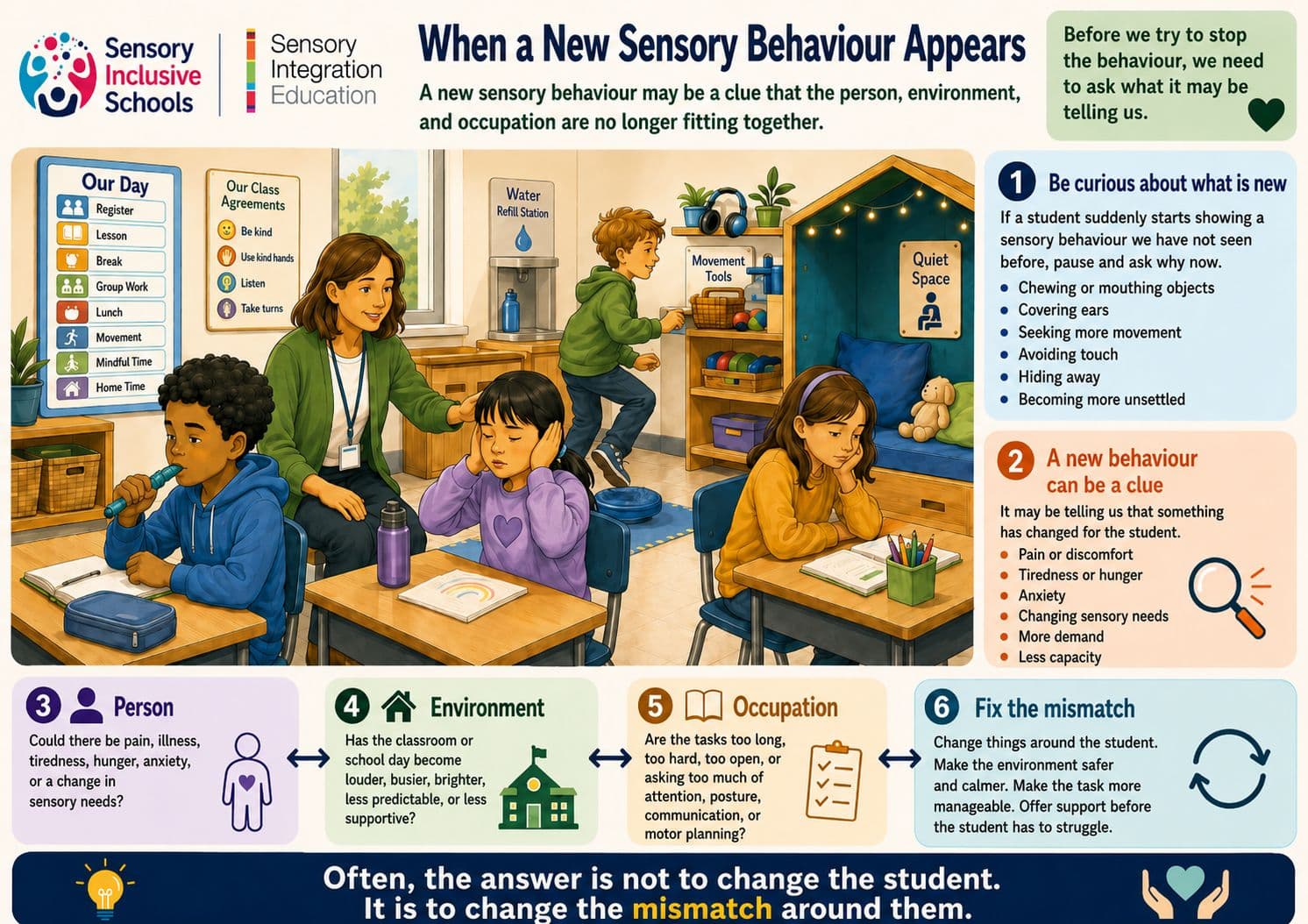 Download this poster here
We would love you to be part of our drop-in sessions - have a look at the SIS Network and the Sensory Inclusion Facilitator for Education pages to learn more.
All the best
Beth